Dolby rebrand
in house strategist @ Dolby
Challenge
Pivot Dolby, historically a licensing and partner based B2B company, to a B2C experience forward company that for the first time, speaks directly to the consumer.
Dolby had spent decades building one of the most recognized names in entertainment technology, but recognition wasn't translating into consumer demand. Brand tracking showed strong awareness of the Dolby masterbrand, but significantly lower recognition of sub-brands like Dolby Vision and Dolby Atmos., suggesting the overall brand was better understood than its product ecosystem. Consumers knew Dolby, but they didn’t know what Dolby meant across experiences.
More importantly, consumers associated Dolby almost exclusively with functional attributes such as quality, reliability, technical credibility, while emotional association, the driver most predictive of brand advocacy and purchase intent, was significantly underdeveloped relative to competitors.
opportunity
I used the brand tracker data to help build a business case for a full B2B to B2C rebrand arguing that Dolby's growth ceiling was directly tied to its inability to create emotional connection with consumers. As the sole strategist on the project, I presented directly to the CMO and executive leadership team, incorporating competitive analysis and brand research showing the long-term revenue impact of brand equity investment. The executive team had operated as a B2B company for decades, and the board was skeptical of the ROI of brand investment. Getting alignment required multiple rounds of presentation, direct response to pushback, and a phased rollout plan that mitigated perceived risk.
solution
The rebrand strategy was built on three interconnected pillars, each grounded in research:
The Why: Shift communications from what Dolby does, providing audio and visual technology, to why it matters: giving consumers transformative, unforgettable entertainment experiences. Consumer interviews showed that people only became genuine Dolby advocates after experiencing it firsthand. This meant our marketing needed to drive trial and emotional connection, not just awareness.
The Master Brand: Research showed that the Dolby master brand carried significantly more consumer equity than the sub-brands. I proposed centering the new visual identity and all marketing communications on "Dolby" rather than "Dolby Vision" or "Dolby Atmos", which would build acround a coherent master brand architecture with "in Dolby" as the connective thread across all entertainment categories: watch in Dolby, listen in Dolby, create in Dolby.
Brand For Me: Brand tracker data showed that emotional brand traits like exciting, cool and a brand for me were the strongest predictors of consumer advocacy in our category, yet Dolby scored significantly below competitors on these factors. I built a positioning strategy specifically designed to close this gap, shifting from a brand that sat invisibly in the background to one that actively invited consumers into its world.
As sole strategist I led the full execution: developing brand architecture, archetypes, personality, values, and voice and tone guidelines. I managbed two copywriters through the evolution of brand language, worked embedded within the design team on the visual identity system, and served as the final decision-maker on revisions across 10+ different product brand guidelines. I presented strategic rationale directly to the CMO and senior leadership at every stage, adapting the narrative based on their feedback while maintaining the integrity of the core strategic direction.
results
The rebrand delivered measurable impact across every metric we set out to move. After running a Music campaign using the new identity, brand awareness increased 4% while emotional brand association increased 9%, directly addressing the gap the strategy was designed to close. Consumer likelihood to seek out an entertainment experience "in Dolby" also increased, placing the brand on par with category leaders Sony and Apple.
Beyond the metrics, the rebrand created organizational alignment around a single brand story for the first time in Dolby's history, which I later turned into an executive corporate brand narrative deck, giving product, sales, regional, and partner teams a shared language and visual system that had previously been fragmented across B2B and B2C functions. The new brand identity, including the iconic double-D portal motif, became a recurring and memorable visual device across all global marketing.
expertise
End-to-end brand strategy ownership at enterprise scale. The ability to build a business case for a significant strategic investment and sell it through to a skeptical executive team. Cross-functional leadership across creative, product, legal, and regional teams. Translating consumer research into brand positioning that delivers measurable business outcomes.
Evolved brand positioning
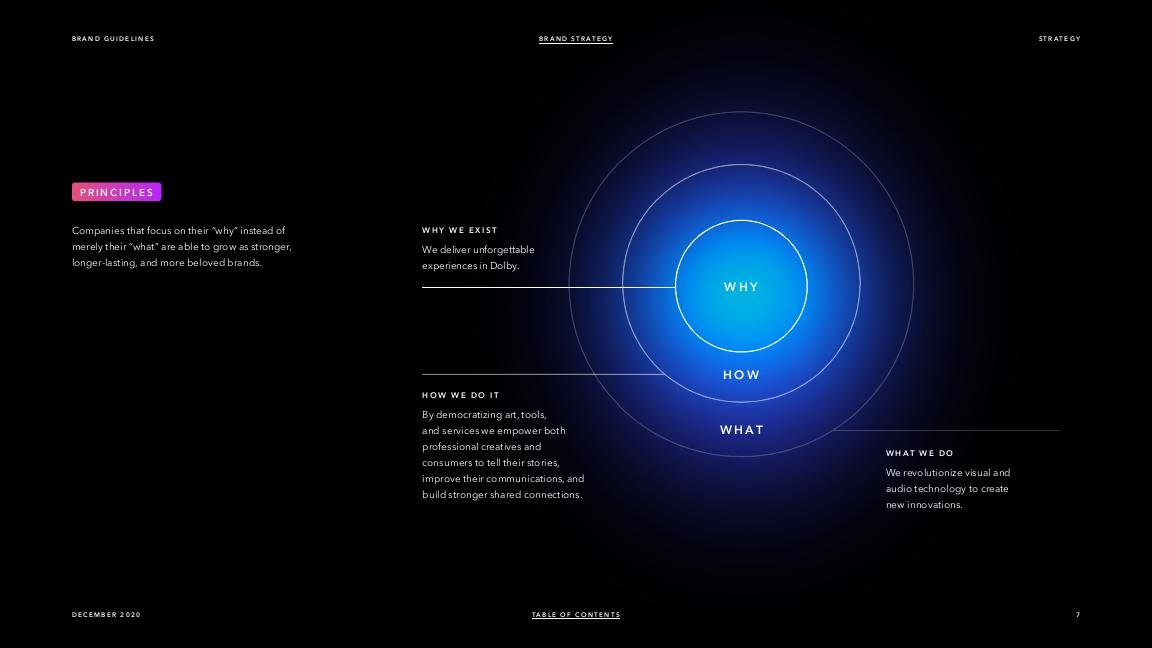
The first step of the process involved reframing the juxtaposition of our desired value proposition (THE WHY) vs our actual product (THE WHAT) and how we offer it (THE HOW).
bROADENING THE AUDIENCE
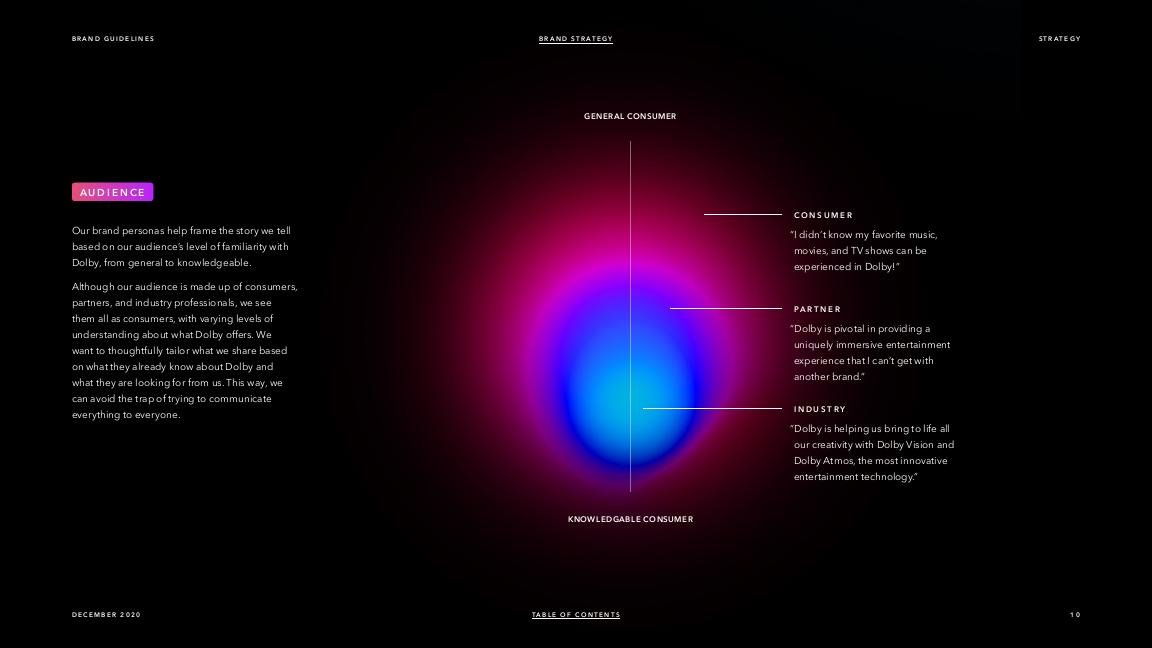
In pivoting the brand, we needed to break apart our multiple audiences and be more specific about the desired takeaway for each of these diverse perspectives.
logo evolution
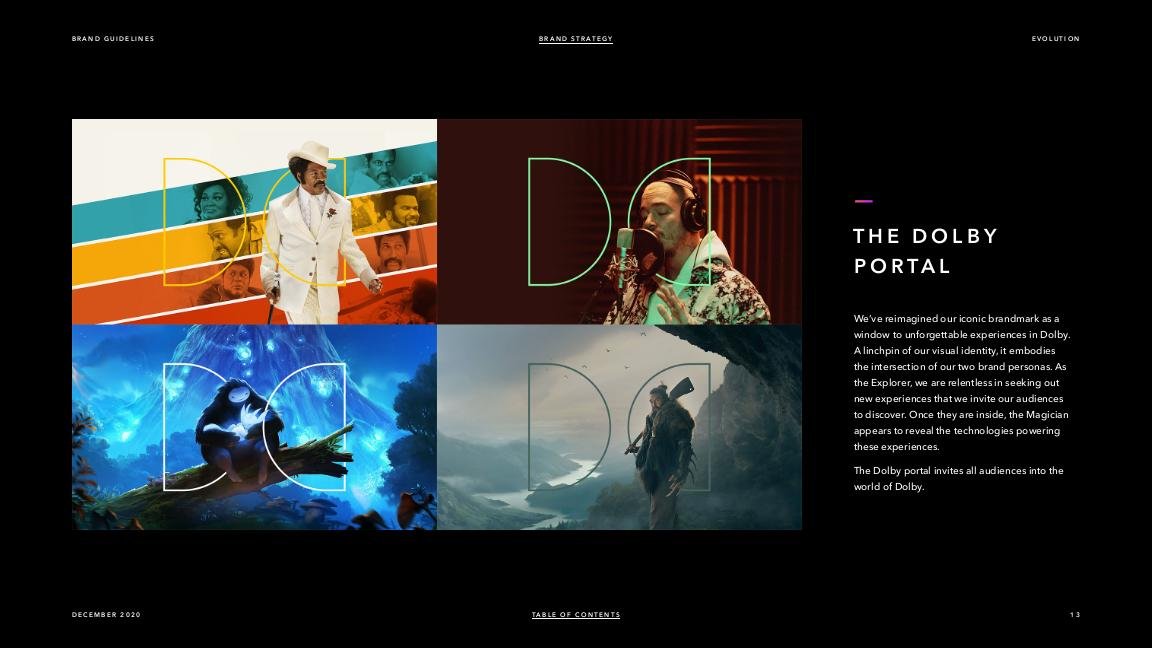
A refresh of the brand’s visual components (the most memorable and visible parts of the brand) was needed to match our new narrative. The evolution of the logo retained historic elements while updating the look and feel. One most notable change was utilizing the iconic double D in our marketing campaigns as a portal inviting people into the world of Dolby.

brand evolution reel
A video created by the team that was used to introduce the brand evolution to internal stakeholders and employees.